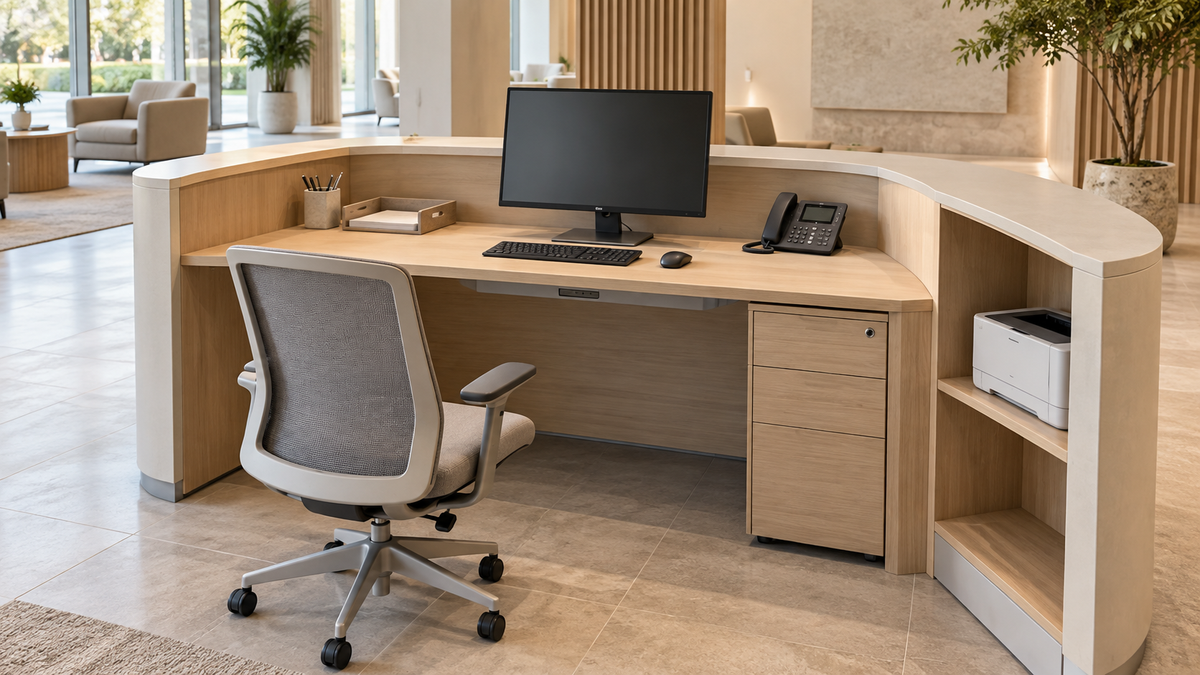
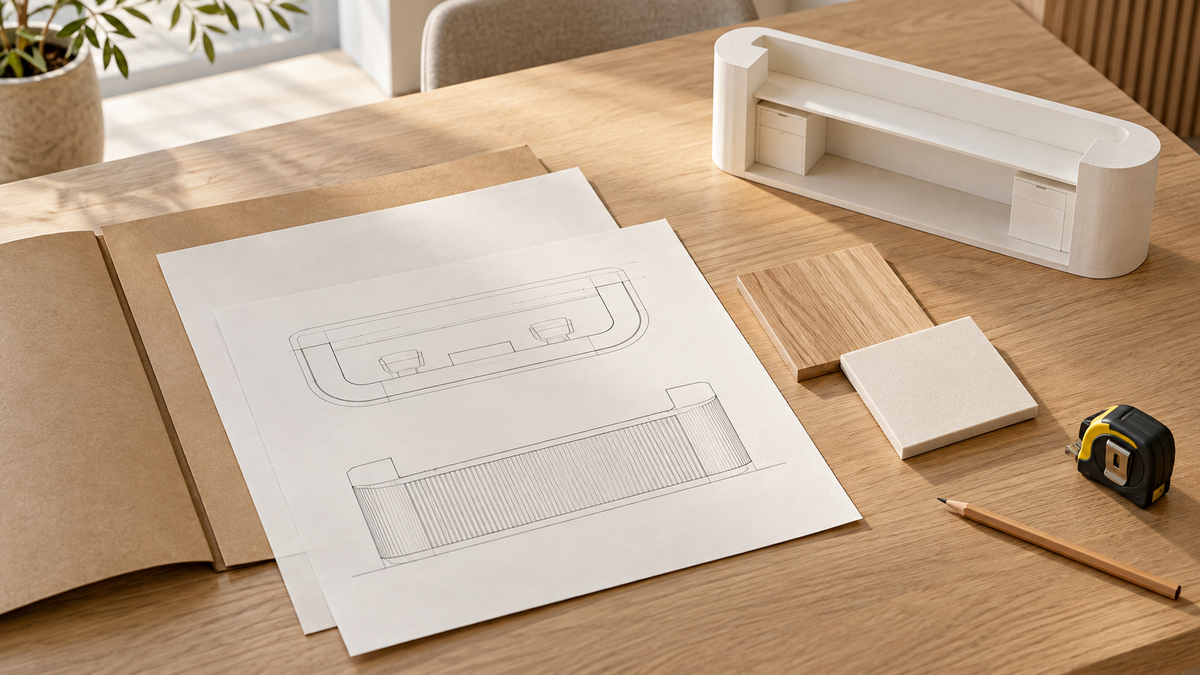
A custom reception desk does not automatically need a physical sample. First identify what is changing and what the available information leaves uncertain. A revised size may be resolved through drawings; matching a new finish to a lobby wall may call for a finish board; an unfamiliar pull or material junction may justify a local mock-up.
Use the comparisons below to choose a useful review. The objective is to resolve the part that could otherwise be misunderstood, with a clear outcome for that decision.
Which changes actually justify a sample?
Start with the row closest to your enquiry. “Check first” is information to request before deciding whether to pay for or wait for a sample.
| Your change | Check first | When a sample adds value |
|---|---|---|
| Length or depth only | Revised plan, front view and staff layout; ask the manufacturer to review the construction for the new dimensions. | The change also introduces an unfamiliar visible curve, junction or working detail. |
| A familiar finish | The actual surface material, finish reference and any difference from the version you have seen. | The material or process changes, or matching an adjoining surface is important. |
| A new colour or sheen | Colour reference, intended sheen, proposed surface and the setting in which it will be viewed. | Existing references leave the colour or reflective effect uncertain. |
| A curved corner or material junction | Radius, edge profile, joint position and adjoining materials on the detail drawing. | You need to judge the visual transition or how the surfaces meet. |
| A new pull or equipment arrangement | Equipment sizes, opening clearances, hardware model and any relevant operating reference. | Grip, movement or access remains difficult to judge after reviewing the layout. |
| Repeated desks across several sites | Which parts repeat, which vary, and how the first assembled item will be reviewed. | A first-item review can resolve details that would otherwise repeat across the order. |
A full prototype becomes worth discussing when several unresolved features need to be assessed together. Agree what it will demonstrate, its cost and its place in the programme before including it.
What would you do in these three situations?
The following are illustrative buying situations, rather than completed project case studies.
1. You like an existing desk but need it longer.
Suppose the reference is 1,800 mm long and your layout calls for 2,200 mm. Begin with an updated drawing showing the overall size, drawer positions, staff entrance and equipment. Ask the manufacturer to confirm the proposed construction for the longer span. A colour sample would not answer those dimensional and construction questions.
Useful request: “Please show what changes from the reference design at the proposed length. Identify any changed joints, supports or working-side positions.” Decide about a sample after those changes are understood.
2. The desk must sit beside a specified white wall finish.
Here, the concern is the relationship between two visible surfaces. Ask for a board representing the proposed desk finish, and review it alongside the wall reference in the intended setting. Check the combination in relevant daylight and artificial light, and view the sheen from more than one angle.
Lighting and sheen affect perceived paint colour; Sherwin-Williams explains both effects. For this decision, a finish board may answer the question without an entire desk prototype. Our materials and finishes guide covers how to describe the proposed surface.
3. You want a new recessed pull beneath the worktop.
Ask the supplier to show the finger recess, drawer front, worktop overhang and opening path together. Check how a user will reach the pull and whether the drawer can open in the planned arrangement. A relevant operating video may help; if the interaction remains unclear, discuss a small working section.

Request the proposed runner model and its planning information. For example, Blum's MOVENTO construction guide specifies dimensions for that system. This illustrates why the chosen hardware's instructions matter; a universal drawer-gap rule would not define your proposed arrangement.
What should you ask before a sample is made?
Put these four points in the request so the supplier can propose an appropriate scope:
- The decision: identify the open question, such as matching the wall finish or confirming the pull grip.
- The representation: ask which materials, coating, edge and hardware the sample will use, and identify any temporary parts.
- The review method: agree whether you need a shipped sample, useful photographs, an operating video or another review arrangement.
- The programme and price: clarify making, shipping and revision time, plus what the quoted sample cost includes.
If the question concerns a curved junction, ask for enough of both adjoining surfaces to see that junction. A flat swatch can still help with colour, but leaves the assembled relationship open.
What does an accepted sample leave unresolved?
Write down the specific feature accepted. Agreement on a painted board's colour does not settle the desk's dimensions, equipment fit or drawer arrangement. Likewise, a video of a similar drawer does not establish the clearances of your revised layout.
Also ask whether a sample represents appearance only or the intended production finish. As a concrete example of why that distinction matters, Benjamin Moore's colour-sample FAQ explains that its colour samples are for colour representation and are not tested for long-term performance. Any performance evidence required by your project needs its own review.
A short note can preserve the decision without turning a straightforward project into a lengthy approval process:
Illustrative review note
Accepted: finish board F-02 for the front-panel colour and sheen, viewed beside the agreed wall reference.
Still open: the recessed pull profile; supplier to show the revised section before that detail is confirmed.
Drawing reference: RD-03, revision B, for the proposed size and layout.
Use references that correspond to your own order. Where a finish or detail changes later, identify which drawing or note needs updating.
What can you send your supplier today?
Copy this request and fill in the open detail. It is suitable for discussing whether any sample is needed in the first place.
We are reviewing [desk reference / drawing revision]. The part still uncertain is [specific finish, junction or function].
Please confirm whether the existing drawings and references can resolve it. If a physical sample would help, propose the smallest useful scope and explain what it will demonstrate.
Please identify the proposed materials and any temporary components, the review arrangement, and the cost and timing, including shipping where relevant.
For a routine design with agreed references, this conversation may lead straight to confirming the order information. For an unfamiliar detail, it gives the sample a defined job. Share your design and the open question with SORVENO, or use our quotation brief guide to prepare the wider enquiry.